Leading Causes of Death in Australia: 2019 vs 2020

Health Statistics
Health statistics are an invaluable tool for measuring the health of Australians and targeting prevention and treatment resources accordingly. In this article, we compare Australia's mortality rating from 2019 to 2020.
Health statistics are extremely important in understanding the health of Australians and identifying key health issues that impact the population. This data helps to inform health professionals of the most prevalent diseases within the population as well as allocate resources for both the prevention and treatment of these conditions. Currently, the most up-to-date health data and statistics available are up until 2020. Using this data provided by the Australian Bureau of Statistics, this article will present and compare the mortality rate for Australia between 2019 and 2020.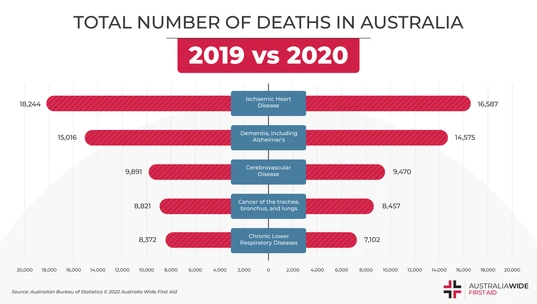
Overall population
According to the Australian Bureau of Statistics, Australia registered and received a total of 169, 301 deaths in 2019. The median age of death for this year was 81.7 years. The top five leading causes of death contributed to just over one-third of the total deaths recorded. In 2019, the top five leading causes of death for Australians were:- Ischaemic Heart Disease with 18,244 deaths recorded
- Dementia, including Alzheimer’s contributes to 15,016 deaths
- Cerebrovascular disease with 9,891 deaths recorded
- Cancer of the trachea, bronchus, and lungs, with 8,821 deaths recorded
- Chronic lower respiratory disease contributes to 8,371 deaths.
- Ischaemic Heart Disease with a total of 16,587 deaths recorded
- Dementia, including Alzheimer’s contributes to 14,575 deaths
- Cerebrovascular disease with 9,470 deaths recorded
- Cancer in the trachea, bronchus, and lungs, with 8,457 deaths recorded
- Chronic lower respiratory disease contributes to 7,102 deaths.
Leading causes of deaths - males
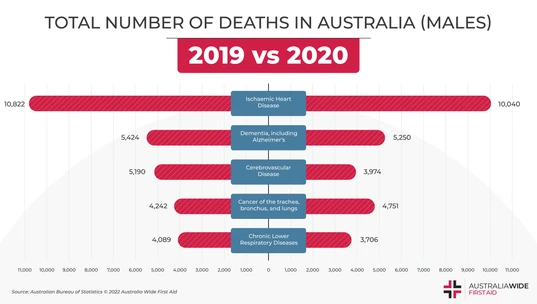
In 2019, 88,346 males made up the total number of deaths in Australia. The top five leading causes of death for Australian men in 2019 were:- Ischaemic heart disease with 10,822 record deaths. This is nearly double the number of deaths as the second leading cause of death
- Dementia, including Alzheimer's disease, with a recorded 5,424 deaths
- Cancer of the trachea, bronchus, and lungs with 5,190 deaths recorded
- Chronic lower respiratory diseases, with a recorded 4,242 deaths
- Cerebrovascular diseases contribute to 4,089 deaths
- Ischaemic heart disease with 10,040 record deaths recorded
- Dementia, including Alzheimer's disease, with a recorded 5,250 deaths
- Cancer of the trachea, bronchus, and lungs with 4,751 deaths recorded
- Cerebrovascular disease with a recorded 3,974 deaths
- Chronic lower respiratory diseases contribute to 3,706 deaths
Leading causes of death - females
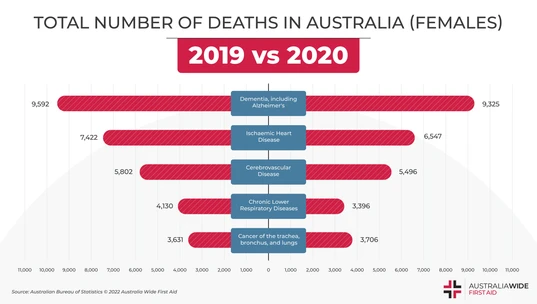
In 2019, the ABS reported a total of 80,955 females made up the total number of deaths within Australia. The top five leading causes of death for Australian women in 2019 were:- Dementia, including Alzheimer’s with 9,592 deaths recorded
- Ischaemic Heart Disease with a total of 7,422 deaths recorded
- Cerebrovascular diseases contributed to 5,802 deaths
- Chronic lower respiratory disease with a recorded 4,130 deaths
- Cancer of the Trachea, Bronchus, and Lungs, with 3,631 deaths recorded.
- Dementia, including Alzheimer’s with 9,325 deaths recorded
- Ischaemic Heart Disease with a total of 6,547 deaths recorded
- Cerebrovascular diseases contributed to 5,496 deaths
- Chronic lower respiratory disease with a recorded total of 4,130 deaths
- Cancer of the Trachea, Bronchus, and Lungs, with 3,706 deaths recorded.
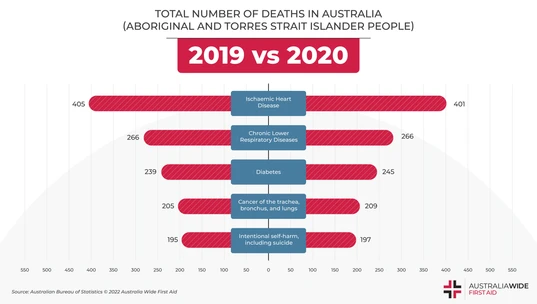
Leading causes of death - Aboriginal and Torres Strait Islander people
According to the ABS, there was a total of 3,435 deaths of Aboriginal and Torres Strait Island people recorded and registered in Australia in 2019. The median age of death for the Aboriginal and Torres Strait Island population was 60.9 years. The top five leading causes of death for Aboriginal and Torres Strait Island people in 2019 were:- Ischaemic heart disease, with a recorded 405 deaths
- Chronic lower respiratory disease with a total of 266 deaths recorded
- Diabetes with a total of 239 recorded deaths
- Cancer of the trachea, bronchus, and lungs with 205 deaths recorded
- Intentional self-harm, including suicide, with a total of 195 recorded deaths
- Ischaemic heart disease, with a recorded 401 deaths
- Diabetes with a total of 266 recorded deaths
- Chronic lower respiratory disease with a total of 245 deaths recorded
- Cancer of the trachea, bronchus, and lungs with 209 deaths recorded
- Intentional self-harm, including suicide, with a total of 197 recorded deaths
Age-standardised death rates
Age-standardised death rates are the average of age-specific mortality rates per 100,000 people. In 2019, the age-standardised death rates for the top five leading causes of death among Australians were:- Ischaemic Heart Disease: 55.5%
- Dementia, including Alzheimer’s: 43.0%
- Cerebrovascular disease: 29.6%
- Cancer in the trachea, bronchus, and lungs: 28.3%
- Chronic lower respiratory disease: 25.9%
- Ischaemic Heart Disease: 49.0%
- Dementia, including Alzheimer’s: 40.5%
- Cerebrovascular disease: 27.5%
- Cancer in the trachea, bronchus, and lungs: 26.2%
- Chronic lower respiratory disease: 22.3%
Final thoughts
Overall, the data shows that there is a slow but gradual decline in both the number of total deaths occurring each year as well as the number of deaths caused by the top five leading causes. However, it is concerning to see the increase in recorded deaths amongst Aboriginal and Torres Strait Island people, and this is a subgroup of the population that the government will look to target with health interventions to help reverse this trend. With the final data and statistics for 2021 still being confirmed by the Australian Bureau of Statistics and other departments, there could be a significant change in the leading causes of death as well as the overall number of deaths with the impact of COVID-19.Resources
- https://www.abs.gov.au/statistics/health/causes-death/causes-death-australia/2019
- https://www.abs.gov.au/statistics/health/causes-death/causes-death-australia/latest-release
Originally published at
https://www.australiawidefirstaid.com.au/resources/leading-causes-of-death
as part of the Australia Wide First Aid Articles Library
Related Articles

Shark Attacks Australia 2022
Home to some of the world's most dangerous shark species, Australia is one of the deadliest countries when it comes to human/shark incidents. In this article, we explore the number and outcome of shark/human incidents that occurred in Australia in 2022, to date.

Leading Causes of Death in Australia 2021
Five diseases accounted for more than one-third of all deaths registered in Australia in 2021. And though our overall mortality rate remains low, Dementia is narrowing the gap to become one of Australia's deadliest diseases.
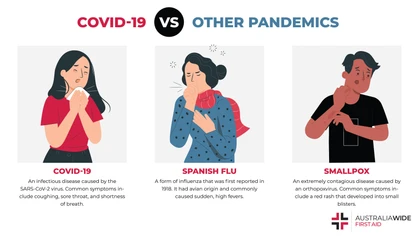
Comparing COVID-10 to Other Pandemics
COVID-19 is one of the first pandemics to drastically impact modern society. However, it is not the first pandemic in human history. Civilisations in times past have been plagued with Smallpox and the Spanish Flu, which share many similarities with COVID-19.
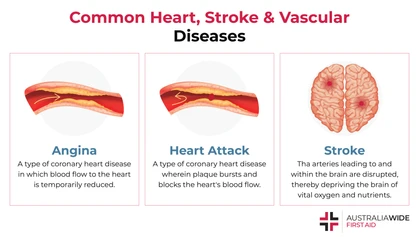
Heart, Stroke & Vascular Diseases Statistics
Heart, stroke, and vascular diseases (or cardiovascular disease) is an umbrella term for a wide variety of diseases that affect the heart and blood vessels. Statistics show that cardiovascular disease accounts for a significant number of hospitalisations and deaths in Australia.

Alcoholism in Australia
Alcoholism, which is more formally known as alcohol use disorder (AUD), is a medical condition in which a person cannot control their consumption of alcohol. AUD is a major health concern in Australia, as alcohol is pervasive in Australian culture.
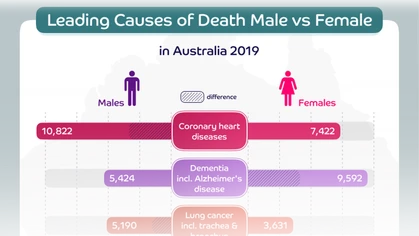
Causes of Death in Australian Men and Women
In 2019 there were 88,346 male deaths and 80,955 female deaths in Australia. What are the leading causes of death among them?
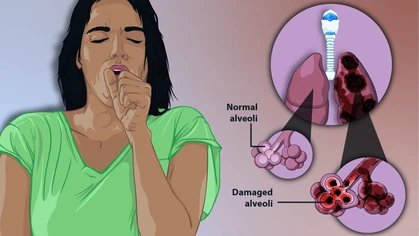
Respiratory Disease Statistics
Respiratory conditions affect the lungs and airways. These diseases can be chronic (long lasting) or acute (short term), causing ill health and disability, and also death.
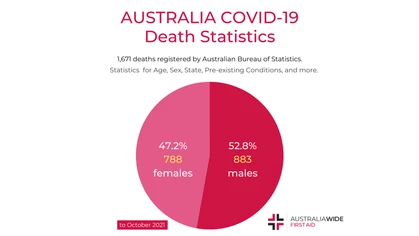
COVID-19 Deaths - Australia Statistics
COVID-19 deaths in Australia, to 31 October 2021, totalled 1,671. This includes 16 suspected as being due to COVID but not confirmed in a laboratory. Pre-existing chronic conditions were recorded on the death certificates of 71.2% of those who died, the most common condition being chronic heart diseases.
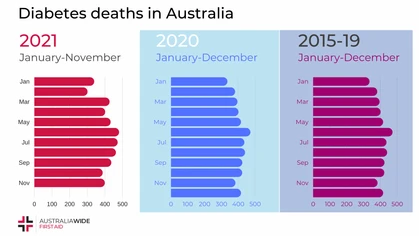
Diabetes Statistics in Australia
Australia recorded 4,535 deaths from diabetes between January and November 2021. While statistics are still being gathered for 2021, this figure is comparable to the 4,515 deaths at the same point in 2020 but 10.4% higher than the 2015-19 average.
Leading Causes of Death in Australia 2019
Five diseases caused more than one-third of all deaths (35.6%) in Australia in 2019. But the way Australians are living and dying is changing. Coronary heart disease, which in 1968, was responsible for almost a third of all deaths, has been declining since.