Brisbane Snakes Identification | Snake Facts

Bites and Stings
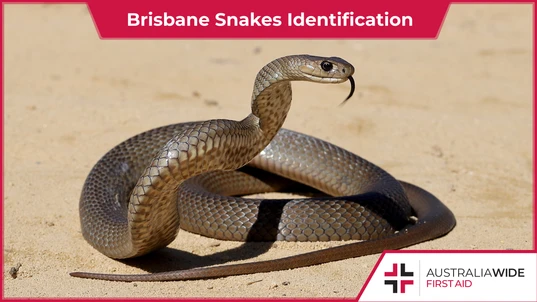
In this article, we provide information on venomous and non-venomous snakes common to the greater Brisbane region, including their preferred habitat, identifying characteristics, and temperament.
Australia is home to roughly 100 venomous snake species, 12 of which have bites that can kill. The greater Brisbane region is home to an abundance of both venomous and non-venomous snake species. These snake species are commonly encountered during the warmer months of spring and summer, when they frequent urban and natural environments in search of prey. Continue reading for more information on where you are likely to encounter these species, what they look like, and what to do if you are bitten by one. We also cover snake bite first aid in our following first aid courses: It is important to note, all snake bites should be treated as venomous until proven otherwise by a doctor at a hospital.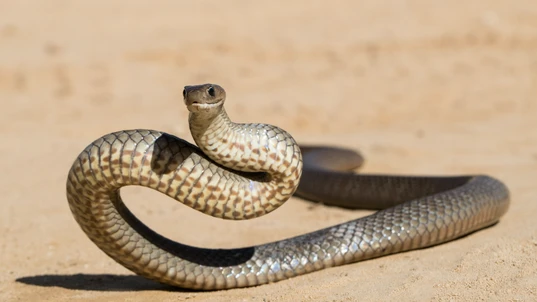
The Eastern brown snake is a highly venomous snake that is commonly encountered in bushland and rural areas of the greater Brisbane region. If provoked, the Eastern brown snake will adopt an S-shape strike position and bite with little reluctance.
The Eastern brown snake
The Eastern brown snake is a highly venomous, medium-sized snake with a slender to moderate build. Their smallish head is almost indistinguishable from their neck. Likewise, their dorsal scales are smooth, slightly glossy, and can be almost any shade of brown, from near black to light tan. Their ventral scales on their underbelly, meanwhile, are generally cream in colour with pinkish-orange blotches. In the greater Brisbane region, the Eastern brown snake is commonly encountered in bushland and rural areas. Eastern brown snakes are an alert and nervous species. If surprised or cornered, they have been known to react defensively and strike with little hesitation. If approached over a distance, however, they generally flee or remain stationary to avoid detection. Eastern brown snake venom is highly neurotoxic and can paralyse the nerves of the heart, lungs, and diaphragm, which can suffocate the victim. It also contains procoagulants, toxins that can hinder blood clotting and put the victim at risk of major bleeding.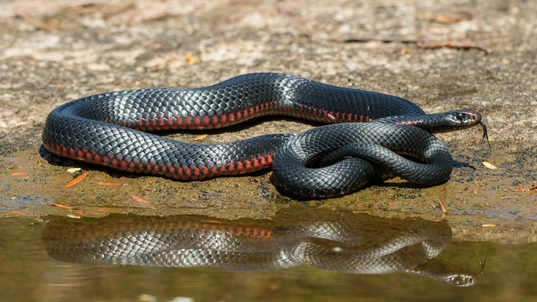
The Red-bellied black snake is a venomous, medium-sized snake that were once common across Brisbane. However, they are now generally restricted to cooler areas in the north and south of Brisbane, due to their predilection for preying on cane toads.
The Red-bellied black snake
The Red-bellied black snake is a venomous, medium-sized snake with a moderate to robust build. Similar to the Eastern brown snake, their head and neck are barely distinct from each other. Likewise, the scales on their head and body are smooth, glossy, and uniformly black in colour. The outer edge of their ventral scales, meanwhile, is bright crimson, though this fades to orange or pink as it reaches the centre of their underbelly. In the greater Brisbane region, the Red-bellied black snake is commonly encountered in cooler areas of the north and south. Red-bellied black snakes are a shy species and will generally only strike a victim under severe harassment. More often than not, they will freeze to avoid detection or flee towards the nearest retreat. Red-bellied black snake venom contains neurotoxins, myotoxins, coagulants, and haemolytic properties. As such, it can disrupt the nervous system and the formation of blood clots, as well as destroy muscle and red blood cells.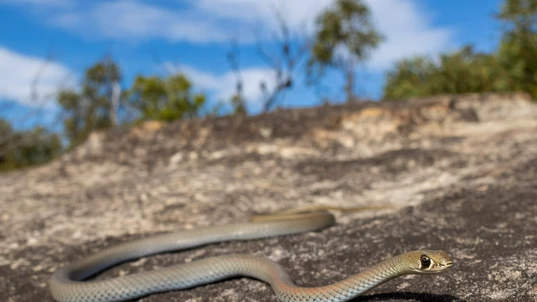
The Yellow-faced whip snake is a venomous snake with a slender build that can be found throughout Brisbane. They are active during the day and are incredibly agile, which allows them to flee quickly when disturbed.
The Yellow-faced whip snake
The Yellow-faced whip snake is a venomous, fast-moving snake with a slender build. Their dorsal scales are generally pale grey to brown in colour, while their underbelly tends to range from grey-green to yellowish. They are also known to have reddish colouring on their head and sometimes tail, and they get their name from a yellow-edged dark bar that runs along the front of their snout. The Yellow-faced whip snake can be found throughout Brisbane in a wide range of habitats, including farmland, open forests, and suburban gardens. Active by day, the Yellow-faced whip snake is an alert species that flees when disturbed. As they are hard to observe closely, Yellow-faced whip snakes are often confused with the Eastern brown snake. And though their venom is far less dangerous, it can cause severe symptoms like pain and localised swelling.The White crowned snake
The White crowned snake is a venomous, dark brown or steely grey snake with a white or yellowish stripe across their neck. They are regarded as one of the most common snakes in Brisbane and have been known to occur in the inner city. More often than not, however, they can be found in compost heaps and other damp areas of the suburban garden. Though White crowned snakes generally rear up and make jerky, striking motions when threatened, this is largely for show, as they are reluctant to bite. White crowned snakes are also considered weakly venomous. However, it is important to remember that many snake species can vary in colour, pattern, and size, and so it can be difficult to make a positive identification. As such, all snake bites should be considered a medical emergency.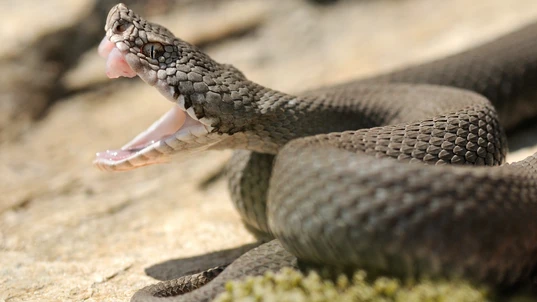
Snake bites can be either dry or venomous, both of which have their own host of symptoms. Dry snake bites are generally characterised by localised pain and redness, while venomous snake bites can encompass more severe symptoms like irregular heartbeat.
Snake bite symptoms
There are two different types of snake bites, both of which have corresponding symptoms:Dry bites
A dry snake bite occurs when a snake strikes a victim but does not release any venom. Dry snake bites are typically painful and can cause swelling and redness. You should call Triple Zero (000) if you sustain a dry snake bite. Though dry snake bites do not require anti-venom, it can be difficult to determine whether any venom is present. Likewise, dry snake bites can come with a host of complications, including anaphylaxis and infection.Venomous bites
A venomous snake bite occurs when a snake strikes a victim and releases venom. Snake bite venom is intended to numb, stun, or even kill prey, so it can cause the following symptoms in humans:- Bleeding
- Swelling and bruising
- Severe pain, either immediate or gradual
- Bite marks present on the skin, ranging from small scratches to obvious puncture wounds
- Anxiety
- Nausea and vomiting
- Blurred vision and dizziness
- Irregular heartbeat and difficulty breathing or swallowing
- Coma or death
- Paralysis
Snake bite first aid
- Keep the casualty at rest and as still as possible to stop the venom from travelling through the body
- Constantly observe and reassure the casualty
- Follow DRSABCD and be prepared to perform CPR
- Apply the ‘pressure immobilisation technique’ (PIT):
If the bite site is on a limb, cover it with a wide heavy elastic bandage (10 - 15 cm wide)
Ensure the bandage is firm and tight, so tight you cannot easily slide a finger between the bandage and the skin
Apply a second heavy elastic bandage. Start from the fingers or toes and wind up the limb as far as possible. Consistent coverage (overlapping half over half) and consistent pressure (firm but not cutting off circulation) are key to an effective PIT - On the bandage, mark the spot where the bite occurred with a pen or felt-tip marker
- Immobilise the limb and joints with a splint, or use a sling if the bite site is on an arm. Keep the limb immobilised until the ambulance arrives
How to avoid snake bites
The best way to avoid snake bites is to leave snakes alone. Never attempt to capture or kill a snake, as they are more likely to attack in self defence. The following precautions, sourced from the Department of Environment and Science, might also help:- Do not wear sandals or thongs when bushwalking. Wear boots and trousers or gaiters instead
- Do not put your hands or feet in or under logs, rocks, or debris without first checking if a snake is present
- Use a torch when walking around campsites or the bush at night
- When in the bush, check inside your shoes, clothes, and sleeping bag before using them
Final thoughts
The greater Brisbane region is home to a diversity of both venomous and non-venomous snake species, the most common of which include the Eastern brown snake, the Red-bellied black snake, the Yellow-faced whip snake, and the White crowned snake. As this article has shown, all of these snake species are reluctant to bite humans. Rather, they would prefer to flee or remain stationary to avoid detection. As such, to avoid sustaining a snake bite, wear boots and trousers when traversing through bushland, do not attempt to capture or kill snakes, and do not put your limbs in or under rocks, logs, or debris without first checking if a snake is present. To learn even more about identifying and treating a variety of snake bites, book a first aid course with Australia Wide First Aid today.
Originally published at
https://www.australiawidefirstaid.com.au/resources/brisbane-snakes-identification
as part of the Australia Wide First Aid Articles Library
Related Articles

The Common Spiders of Darwin
Darwin, the tropical capital of Australia’s Northern Territory, is home to a rich diversity of wildlife - including an impressive array of spiders. From the sprawling webs of golden orb-weavers to the cryptic camouflage of trapdoor spiders, these arachnids play a vital role in the local ecosystem. While some may inspire fear, the majority are harmless and even beneficial, helping to control insect populations.
First Aid for a Cat Bite
Cat bites, while often underestimated, can lead to serious health complications if not treated promptly and properly. Cats' mouths harbour a variety of bacteria that can cause infections in humans.
First Aid for Drop Bear Attacks
Encounters with wildlife can often be thrilling, but when it comes to the creature known as the drop bear, the experience can quickly turn dangerous. A sharp increase in recent attacks prompts the need for understanding proper first aid procedures in case of an attack.
First Aid for Funnel Web Spider Bites
Encountering a funnel web spider can be a frightening experience, and if a bite occurs, it is crucial to act swiftly and effectively to minimize the potential risks associated with their venom.
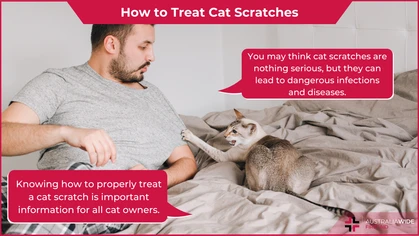
How to Treat Cat Scratches
Cats are beloved pets for millions of people worldwide, but sometimes even the most gentle feline can become agitated or scared, leading to scratches. While cat scratches are usually not serious, they can still be painful and carry the risk of infection.
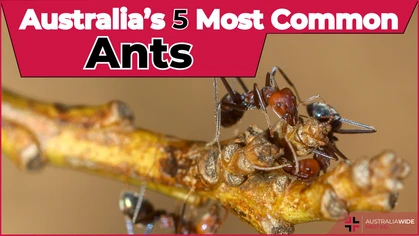
5 Most Common Ants in Australia
Australia is home to a remarkably diverse array of ant species, showcasing a fascinating range of characteristics and behaviours. By understanding the identification, range, and behaviours of these ants, individuals can navigate their surroundings with greater awareness and appreciation.
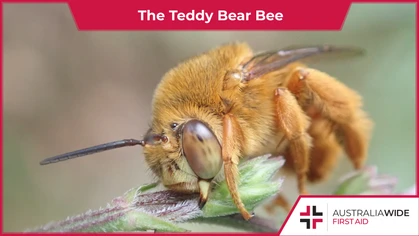
5 Most Common Bees in Australia
Recognizing the significance of bees' positive impact, it becomes imperative to acquaint ourselves with the various species, distinguishing characteristics, geographical distributions, stinging tendencies, and suitable first aid measures for bee stings.
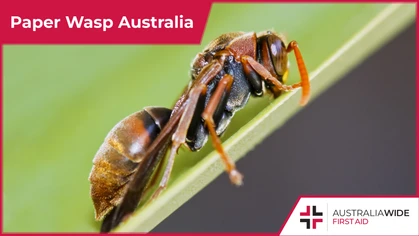
5 Common Wasps in Australia
Australia is home to a diverse range of insect species, including several types of wasps. While some wasps are beneficial as predators of other pests, others can pose a threat due to their stinging capabilities.
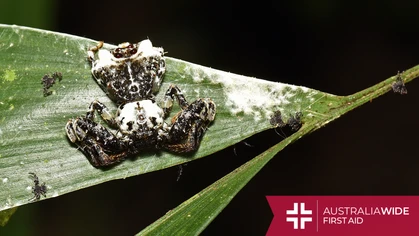
The Bird Dropping Spider: A Master of Mimicry
As their name suggests, the Bird Dropping Spider has developed colorations and patterns that mimic bird poo. This ingenious disguise means they can thrive in a wide variety of habitats, including suburban gardens.
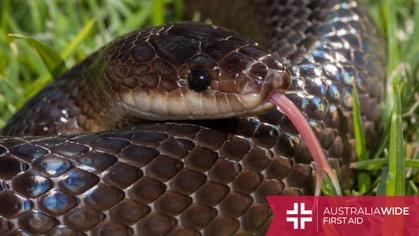
The Slaty Grey Snake | Snake Facts
One of the most common snake species in Darwin and Australia's Top End region, the Slaty grey snake is a medium-sized species with shiny scales. They have been known to defend themselves aggressively when disturbed.